Hellenic Polytheism
About this tradition
Hellenic polytheism, whose practitioners call their religion Hellenism or Hellenismos in homage to the Emperor Julian's fourth-century use, and which is also known as Dodekatheism, twelve-god-ism, or Greek reconstructionism, is the modern revival of the religion of the Greek gods. Its contested status is unusually public: historians hold the ancient religion extinct by the ninth century at latest, with isolated survivals on the Mani peninsula into the twelfth, and the revival's own claims of continuity are unproven, while the academic world splits between the classicist who mocked the revivalists until they got real and slaughtered a bull in central Athens, and the scholar of Greek religion who answered that contemporary Pagans' re-imaginings differ little in kind from the bricolage of the ancient religion itself. What the practitioners themselves emphasize is that the religion runs on orthopraxy, right practice, rather than doctrine: as one community formulation has it, it doesn't matter if you have read Homer or Hesiod, the most important thing is piety.
The beliefs are pluralistic by design: hard polytheism, animism, and monism are all held compatible, the Twelve Olympians standing among nymphs, heroes, chthonic deities, and the deified dead, the same gods worshipped in local and universal aspects, and the myths read as sacred stories rather than literal history. The ethical vocabulary is ancient: eusebeia, reverent conduct, arete, excellence, and xenia, guest-friendship under Zeus's protection, with guidance drawn from the Delphic Maxims, the Tenets of Solon, and the Golden Verses of Pythagoras, and reciprocity with the gods, kharis in the practitioner literature, as the relationship's working principle.
Practice centers on offerings and libations, the ancient maxim holding that without sacrifice prayers are only words, made at household altars and public ones, with purification before approach. Animal sacrifice divides practitioners, some reviving it, most refusing it, with fruit, bread, and cake as the common symbolic substitutes, and household worship carries the weight: the monthly cycle of Deipnon offerings to Hekate at the dark moon, Noumenia for Apollo and Hestia at the new moon, and Agathos Daimon the day after. Festival dates follow the lunisolar Attic calendar through the year's round of Anthesteria, Dionysia, Thargelia, Panathenaia, Thesmophoria, and the rest, each organization publishing its own calendar.
Where it came from, briefly: the ancient religion ran from Mycenaean roots through the Homeric and Hesiodic texts that became its literary canon, the city cults, and the separate mystery cults of Eleusis, Dionysus, and Orpheus, until the Roman Christianization of the late fourth century and the closing of the Athenian schools in 529 ended its public life. The revival's lineage claims run through Gemistos Plethon's fifteenth-century pagan circle at Mistra, the eighteenth-century English Platonists, and Romantic poetry's pagan moment, with organized modern practice beginning in twentieth-century America and the Greek organizations formalizing from the 1990s.
Today's institutions cluster in Greece: the Supreme Council of Ethnikoi Hellenes, established in 1997 after the 1995 Hellenic National Assembly on Olympus, the Dodekatheon, Labrys, Ellinais, and Thyrsos, with the American Hellenion and Elaion organizing the diaspora. The first modern Hellenic temple was completed at Oraiokastro near Thessaloniki in 2009, two more followed, and the legal milestones are dated and real: a 2006 court recognition, the first rite at the Temple of Olympian Zeus in 2007, performed there for the first time since the late-Roman bans, and 2017's official known-religion status for the Hellenic Ethnic Religion, an administrative recognition that stops well short of the Orthodox Church's standing. Movement-affiliated estimates put a few thousand devotees in Greece, with a much larger circle of interested people, figures offered as movement estimates since no census category exists.
Access is open: no initiation is required, self-taught household practice is normal, organization membership is optional, and the public rituals are public. The one live tension, worth stating in the tradition's own terms, is the ethnic framing: Greek organizations present the religion as Greece's ancestral inheritance, a heritage claim rather than a racial one in their usage, while the standing of non-Greek practitioners remains a genuine community debate, and mystery-cult-flavored groups may be initiatory as their ancient models were.
also known as Hellenism
Cultural family
Where it’s found
Access
5 practices
Altar Craft
Making and keeping the altar: the household gods' niche and the butsudan's cabinet, the ancestor's photographs and the working tools, and the maintenance that is the craft.
Augury & Omen Reading
Reading omens in the living world: the flight of birds, the weather, chance encounters, the signs the day itself offers.
Moon & Seasonal Ritual
The witch's calendar: the lunar esbats and the eight sabbats of the wheel of the year, its documented mid-century construction, and the living practice it organized.
Sacred Site Pilgrimage
Journeying to sacred places: the Camino's record years, Glastonbury's layered pilgrimage, Sedona's invented vortexes, and the communities revoking access.
Sacred Vocal & Instrumental Music
Devotional singing as practice: the chant traditions, the kirtan call-and-response, the qawwali's ecstasy, and the wellbeing research on group singing.
Go deeper
Immerse yourself
Learn it and visit it: courses that teach hellenic polytheism, and the places held sacred to it.
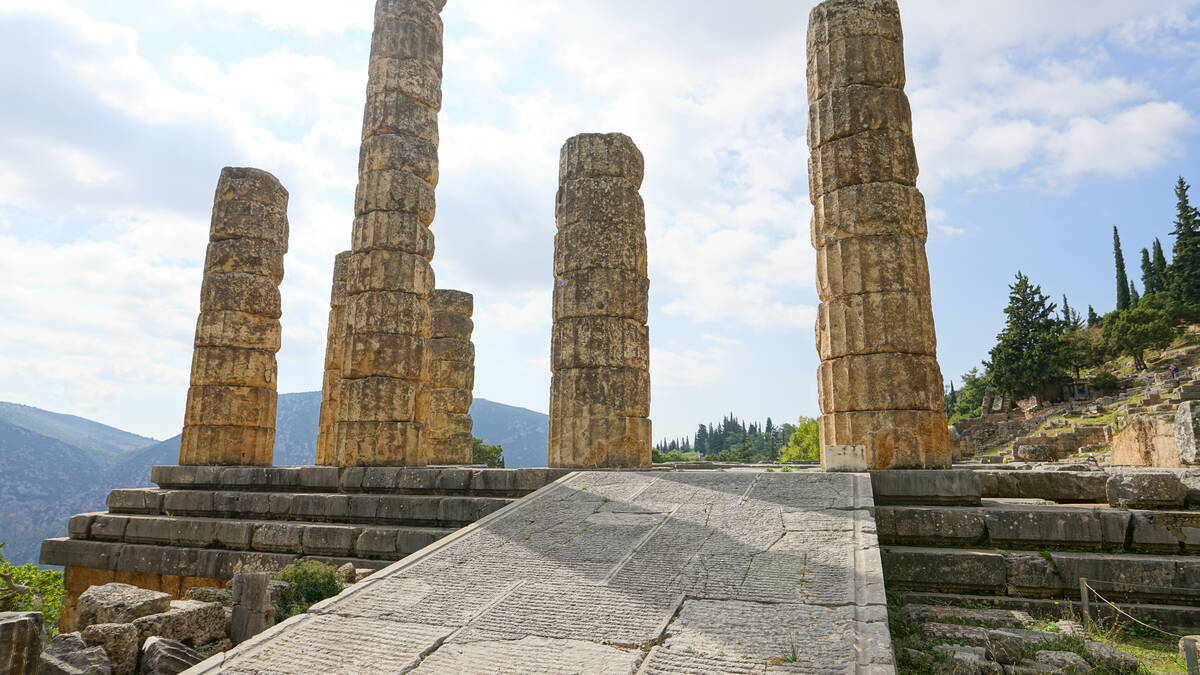
The lineages
Institutions & businesses
Organizations whose work centers on hellenic polytheism.