Santería / Lucumí

About this tradition
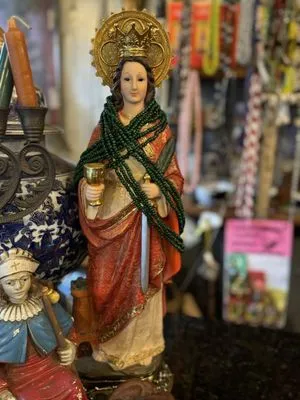
Santeria is the Afro-Cuban religion known to its practitioners as the Regla de Ocha or the Lucumi way, a name they increasingly prefer over the older label whose emphasis on saints they find misplaced: the religion of the orishas, the Yoruba deities who carry the life-force the tradition calls ashe, served under a supreme being and alongside the blood ancestors. The Catholic saints' names remain attached to the orishas, Changó to Saint Barbara and Ochún to the Virgin of Charity, a syncretism that was survival, but the religion's substance is Yoruba: the divination systems that direct every decision, the offerings that feed the deities, and the drum ceremonies where dancers are possessed.
The divination is the religion's daily architecture, and it runs on three systems: the cowrie-shell oracle of the diloggún, cast by priests of either sex, the count of open shells selecting one of the sixteen primary figures that combine into the full corpus; the coconut oracle available to anyone who has received the first initiations; and Ifa, the palm-nut and chain system of the babalawos, the sixteen by sixteen corpus of two hundred fifty-six figures transmitted orally and honored by UNESCO as intangible heritage, its priesthood traditionally male though women have entered it in American communities this century. Every reading arrives as either a blessing or an obstacle, and the diviner prescribes the offering that answers it.
The initiation system is the religion's structure: no one proceeds without a godparent, the chosen kinship that forms the house, the temple without central authority. The stages run from the consecrated beaded necklaces that bind godparent and godchild, through the warriors, the first deities received which carry permission to divine, to the crowning itself, the week-long ceremony in which the tutelary orisha's essence is seated in the initiate's head, with the predictions recorded in the initiate's own book and a ritual name revealed. The year that follows, the year of the newborn priest, prescribes white dress and covered head and a discipline of restrictions that closes with its own ceremony and an annual birthday of the saint thereafter. The cost is real, roughly a year's wage in the American houses, and the details are deliberately kept from the uninitiated.
Where it came from, briefly: enslaved Yoruba arrived in Cuba in the hundreds of thousands across the nineteenth century, and the ethnic mutual-aid societies incubated the religion under the only legally permitted faith; the abolition of slavery did not legalize it. The revolution's restrictions continued, and the American spread came through the sixties' arrivals and the boatlift of 1980, whose priests founded the houses of Miami and New York. The religion's legal record is its own modern history: the Supreme Court's unanimous 1993 ruling for the Hialeah church established that ritual animal sacrifice is protected exercise, the Fifth Circuit's later ruling extended the protection to a Texas priest's home practice, and the religion's public standing in America descends from those cases.
The numbers run to hundreds of thousands in the United States, house-based and uncensused, and to the majority of Cuba's population touched by some Afro-Cuban practice. Access is initiation-gated: the godparent system governs, the year of seclusion follows, and the details stay within; but the drum ceremonies are public rites anyone may attend, the consultations open to clients, and the first initiations available to those who never intend to crown. Its counsel is the religion's own: ashe moves through the orishas and the ancestors, the divination directs, and the character the tradition says the oracle reads is the initiate's lifelong work.
also known as Regla de Ocha
Cultural family
Where it’s found
Access
The lineages
Institutions & businesses
Organizations whose work centers on santería / lucumí.