Shamanic Journeying
Shamanic journeying is the drum-driven voyage to the worlds the tradition maps as three: the lower world reached through a tunnel imagined into the earth, the upper world above, and the middle world of ordinary and nonordinary reality, where the practice's dangers are said to live. The method's core is the question carried before the drum starts: the journeyer lies with a hand over the eyes, formulates one purpose, visualizes the entry, passes through, and meets the beings of the landscape, the power animal the canonical first encounter, the compassionate teacher its upper-world counterpart, and returns when the callback sounds, the rattle's changed rhythm or the drum's return signal. The drum's role is the method's founding discovery: the anthropologist who concluded that most of the world's shamanic cultures use monotonous percussion rather than plants built his system on the drum as the legal, safe, effective substitute, the standard tempo near four beats a second, the shamanic state of consciousness his system's name for what the drum induces.
The method's author gave it its history: the academic anthropologist whose fieldwork among the Shuar of Ecuador and the Conibo of Peru supplied the material, whose first ayahuasca session opened his training, whose book of 1980 was the first print exposition of the drum journey, published alongside the first recorded drumming tape, and whose foundation, endowed by a Rockefeller, grew into the field's institution, its courses run on four continents, its indigenous assistance program funding revivals from Tuva to the Sami when invited, its scale by the century's end five thousand students a year. The system's cosmology is the founder's synthesis: the upper and lower worlds wholly nonordinary and beyond suffering, the middle world the mixed zone where sorcery lives, the distinction drawn from the ethnographic contrast between his two Amazonian peoples.
The practice's evidence is the neuroscience of the state it produces: the controlled study of novices finding the shamanic instruction set, not the drum alone, shaping the experience's phenomenology, the cortisol dropping equally everywhere; the phenomenological study mapping thirty-one categories of journey experience; the imaging studies mixed on theta and clear on the brain's network reconfiguration; and the most recent work, forty subjects and three drumming tempos, finding that theta-band neural tracking predicted altered-experience scores rhythm-specifically, the strongest evidence yet that the traditional tempo does something distinct, the authors agnostic between entrainment and evoked response. The tradition's own claim is ontological, spirits real and the state a doorway, not medical, and the psychology literature reads the journey as guided imagery inside an altered state, the two frames coexisting as the field's dual bookkeeping.
The critique is the practice's permanent companion, and the entry carries its substance: the scholars of neoshamanism naming the homogenization, the neo-shaman never needing to know a traditional shaman to learn the techniques, the native shamans used to legitimate what borrowed from them; the American Indian studies article that made plastic shamans a term of art; the sweat-lodge deaths of the commercialized market's most notorious case, the tribal leaders' testimony that the ceremony bore little resemblance to the real thing; and the defenders' responses, the foundation's anthropologist ally calling the approach conservative and purist, the founder's own line that shamanism is not new age but stone age, and the critic who nonetheless practices, holding the journeyers' experiences comparable to the traditional ones and calling for dialogue rather than dismissal. The census data point the field's growth: the write-ins for shamanism in England and Wales multiplied tenfold in a decade.
Access is open but taught: no prerequisites at the bottom, the deeper work gated by completed prerequisites, recording prohibited, and the foundation certifying no one, its FAQ stating that no person can certify a shaman, it is the helping spirits who do that. The practice's counsel is the method's own: one question per journey, the callback honored, and the worlds entered with the same discipline they are left with.
At a glance
- Category
- Shamanic Practice
- Origin of practice
- The method extracted from Amazonian fieldwork and codified in New York, 1980
- Access
- OpenOpen to all , no initiation required. What access means
Traditions
The living lineages this practice moves within.
Tools & Materials
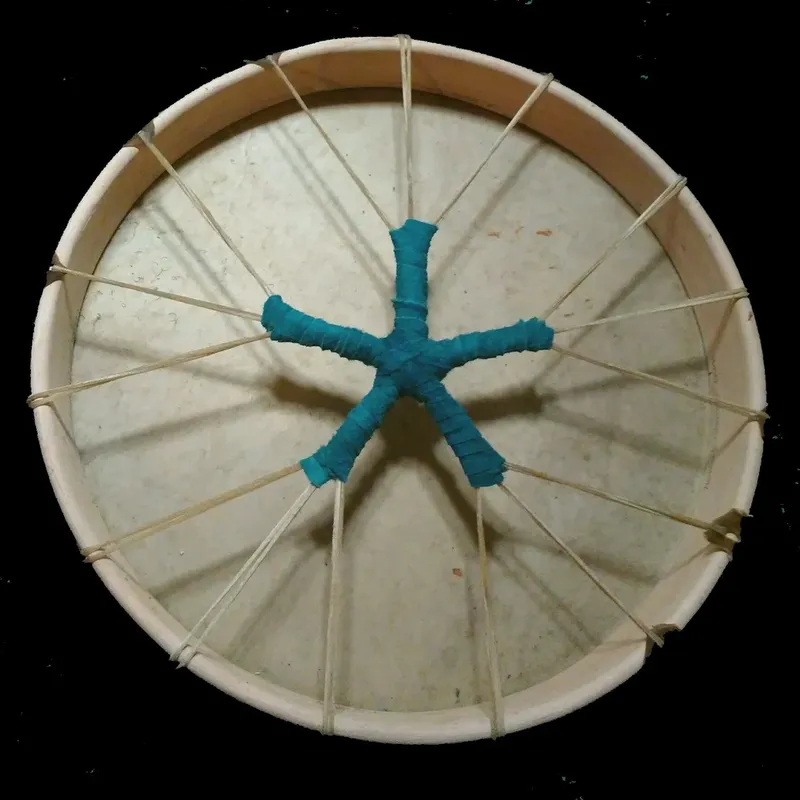
The shamanic journeyer's tools are the drum and the eye cover: the monotonous percussion at the tradition's standard tempo, recorded or live, with the callback built into the tape, and the blindfold that closes the journeyer's eyes to the room. The method's instructions are its deeper instruments: the one pre-formulated question, the entry hole visualized, the tunnel passed through, the beings met, the return by the same door. The workshop supplies the group format: instruction, group drumming, individual journeys, and the paired sharing that processes the experience. The foundation's curriculum is the practice's ladder, from the basic weekend through the advanced trainings in extraction and soul retrieval to the three-year program, its certificates of completion the only credential it issues, the shaman's certification belonging to the spirits by its own doctrine. The market extends the method: the on-demand courses, the drumming tracks with callbacks sold on the meditation apps, the drum itself the practice's one essential purchase. What the tools cannot replace is the question: the journey without a purpose is the method's definition of a tour rather than a working.
Elements & Concepts
The three worlds. Upper and lower wholly nonordinary, middle the mixed zone: the cosmology the method teaches, its geography organizing every journey.
Sonic driving. The drum's repetitive rhythm inducing the shamanic state: the method's founding technique, its tempo standardized, its effects now the neuroscience's subject.
The power animal. The canonical first encounter, the animal ally retrieved and kept: the journey's signature achievement, and the practice's most-copied rite.
The callback. The signal that ends the journey, the rhythm's change calling the traveler home: the method's discipline of return, and its safety structure.
The organizations
Institutions & businesses
Organizations whose work centers on shamanic journeying.