Wicca
About this tradition
Wicca is a religion, and the entry's first job is to say what that means: its practitioners worship deities, keep a liturgical calendar, celebrate rites of passage, and consider themselves members of a coherent faith rather than practitioners of a hobby. It is also, unusually for a religion, young enough that its own scholars can date its founding precisely, which is why "is it really a religion?" is a question Wiccans themselves debate and courts have answered: a United States federal court recognized it as a religion in 1986, and the military chaplaincy, the veterans' headstones, and the national censuses have treated it as one since.
What Wiccans believe, in the mainstream form: divinity is embodied in a Goddess and a God, often imagined as a triple moon-mother-crone Goddess and a horned God of wild nature. This duotheism is the classical teaching, and it is not universal: many Wiccans are effectively polytheists serving many deities, some are pantheists who see divinity in nature itself, and others treat the God and Goddess as psychological archetypes rather than literal beings. What holds the religion together is less a shared creed than a shared practice: the circle.
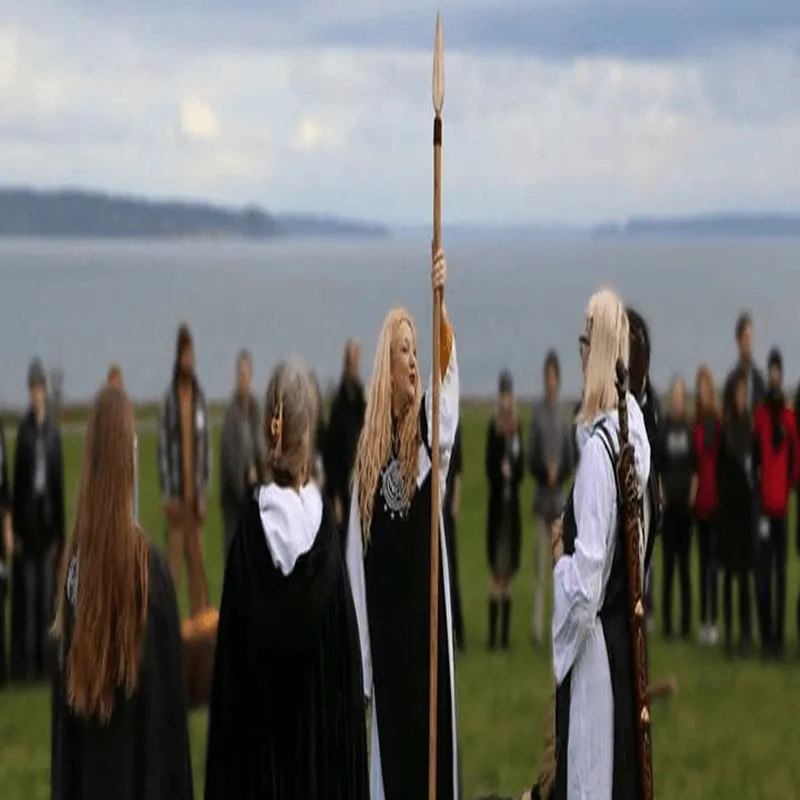
The circle is Wicca's central act. Participants cast a boundary between the ordinary world and the sacred one, call the four directions, invoke their deities, raise energy for magical work, share food and drink, and close the circle. Within it they celebrate two rhythms: the eight festivals of the wheel of the year, four drawn from the ancient Celtic calendar (Samhain, Imbolc, Beltane, Lughnasadh) and four from the solstices and equinoxes (the modern Yule, Ostara, Litha, Mabon), and the thirteen full moons, at which covens or solitaries work what they call esbats. Magic is the religion's working vocabulary: Wiccans cast spells for healing, protection, prosperity, and love, under an ethic of not harming, phrased in the tradition's most-quoted line, "an it harm none, do what ye will."
Where it came from, briefly: Wicca was founded in England in the 1940s and 1950s by Gerald Gardner, a retired civil servant who claimed initiation into a surviving witch coven and, when the evidence for the coven failed to hold, built the religion from the era's ceremonial magic, folklore scholarship, and romantic revival anyway. The founding priestess Doreen Valiente rewrote the liturgy into the tradition's enduring voice. The result is what its leading historian calls the only fully formed religion England has given the world, a new religion wearing old names, a fact most practitioners now know and accept.
What it looks like today: two worlds under one name. The initiatory traditions, Gardnerian and Alexandrian, keep covens of initiates, degrees of training, and oathbound material, and you cannot read your way into them; you are brought in by someone already inside. The larger world is eclectic and solitary: people who found Wicca through books and the internet, self-dedicate, practice alone or in casual groups, and mix Wicca with whatever else they practice. The self-taught side is the demographic majority, and the initiatory side is the tradition's credentialing core, and the two coexist in tension and kinship.
The community is organized around covens, festivals, and the internet: small working groups that meet on the moons and sabbats, the larger public gatherings (Pride rituals, pagan pride events, pub moots, and the camp festivals where Wicca overlaps with the wider pagan scene), and the vast online infrastructure of books, podcasts, and social platforms where most people now first meet the religion. Wicca's numbers are estimated in the hundreds of thousands worldwide, growing from near-invisibility in the 1990 censuses to a visible minority religion in the Anglosphere.
Its counsel, in the tradition's own terms: the circle is the practice, the Rede is the ethic, and the Goddess and the God are met in the ritual year rather than argued into existence. Whether one finds a coven or a book, the entry of the tradition is the same: cast the circle, keep the festivals, and do no harm.
also known as Wicca, The Craft, Neopagan Witchcraft
Cultural family
Where it’s found
Access
6 practices
Candle Magic
The candle as the spell: dressed, carved, and burned while the flame works the petition, the burn read for omens, the tradition codified in 1940s New Orleans.
Elemental Magic
Working with the four elements: the ancient doctrine, Paracelsus's elemental spirits, the Golden Dawn's grades and pentagram rituals, and the quarters every witch calls.
Incense, Oil & Potion Craft
Making the magical preparations: incense blended and burned, condition oils made and named, the potions and philtres, and the supply trade that codified it all.
Moon & Seasonal Ritual
The witch's calendar: the lunar esbats and the eight sabbats of the wheel of the year, its documented mid-century construction, and the living practice it organized.
Spellwork
The practice of magical workings for goals: the spell's anatomy, the cunning folk's services, the revival's spell books, and the cast-for-you market they became.
Tarot Reading
Reading with the 78-card tarot deck, where card meanings, spread positions, and the reader's own intuition meet the question a person brings.
Go deeper
Immerse yourself
Learn it and visit it: courses that teach wicca, and the places held sacred to it.
The lineages
Institutions & businesses
Organizations whose work centers on wicca.