Enochian Magic
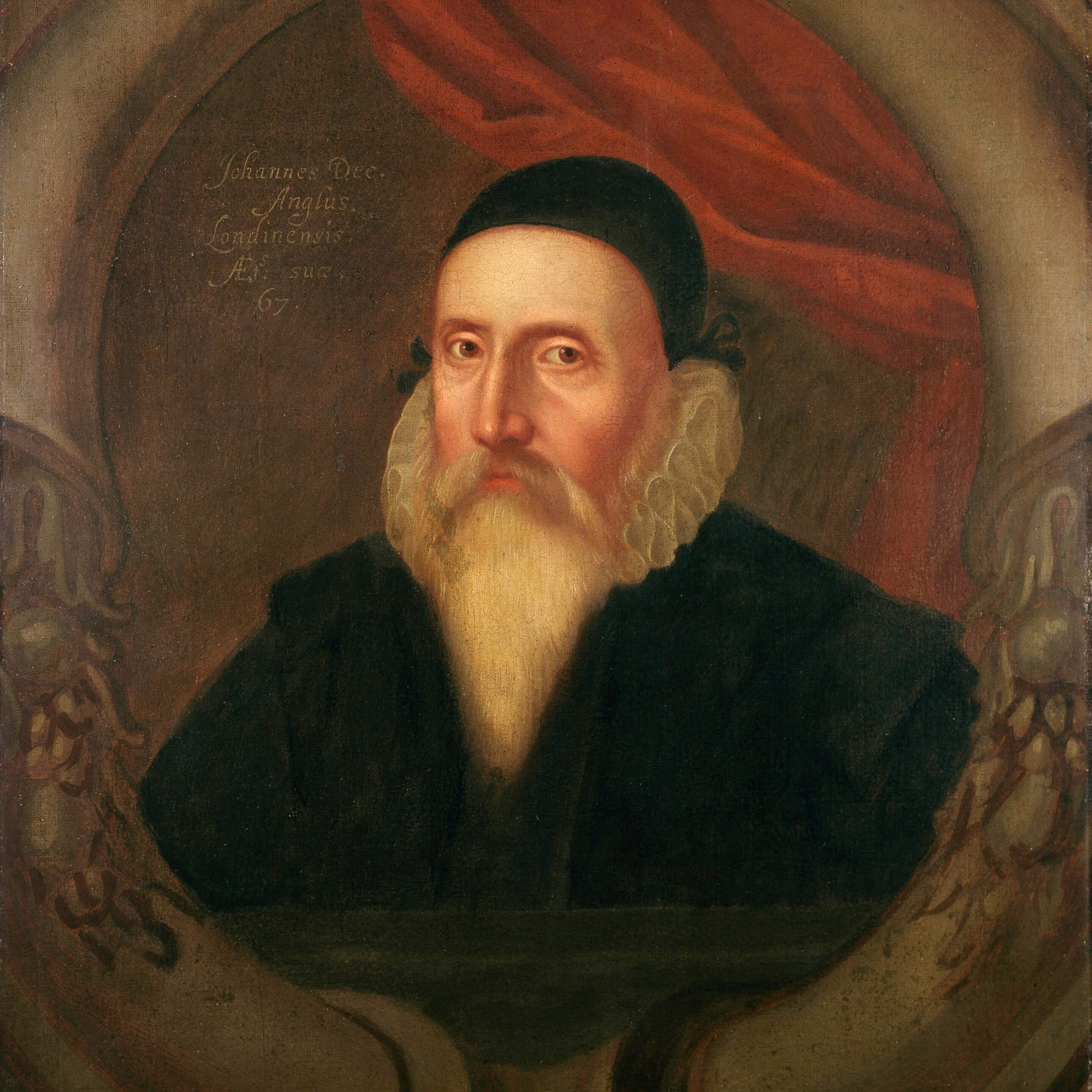
Enochian is a language said to have been received from angels: the script and vocabulary recorded across the scrying sessions of the Elizabethan mathematician and his skryer in the fifteen-eighties, the tongue the tradition calls the language of angels, named for the patriarch held to be its last human speaker before the sessions. The system built on it is vast and specific: the great table of four elemental watchtowers plus a tablet of union, the nineteen calls or keys that open the system's realms, the thirty aethyrs rising in rank, each governed by its named and sealed officers, and the temple furniture, the holy table and the wax seals derived from an older medieval source the mathematician owned, the ring and the rod.
The reception's record is the diaries themselves, and their mechanics are the tradition's most documented miracle: the skryer seeing the angel's finger point at cells in the crystal, the letters located by coordinate on prepared tables, the messages dictated backwards as too dangerous to give forwards. The alphabet appeared first, then the book of ninety-eight letter-tables never translated, then at a foreign court the calls with their English translations. The partnership ran across Europe's courts, the mathematician advising emperors and the skryer rising with him, until the shared-wife command that broke it; the mathematician returned to a vandalized library, and the system's own use remains his biographers' open question: no descriptions of evocation ritual survive in the extant diaries, yet the wax seals survive in a national museum and one manuscript compiles the conjurations as a working collection, the practice's founding ambiguity preserved in the objects.
The transmission passed through the antiquarians: the publisher whose hostile introduction fixed the founder's duped image for two centuries and whose transcription errors corrupted the text, the collector who preserved and annotated the manuscripts now catalogued in the British Library. The Victorian order incorporated the material into its curriculum, grafting the aethyr workings onto its adept curriculum and building the four-player divination chess whose own historian admits almost nobody could play, and the psychologist of another order judged the system incomplete and dangerous, claiming witnessed breakdowns, and stripped it from his curriculum entirely. The publication of the order's papers in the nineteen-thirties put everything into public hands, and the modern revival runs on those editions: the critical transcriptions, the practical manuals, the desert workings of the occultist whose vision record remains the system's most-read account, one aethyr per day across Algeria, the seer in deep trance and the scribe recording.
The linguistic verdict is the entry's scientific counterweight, and it is specific: the philologist who compiled the system's dictionary found nothing extraordinary, some two hundred fifty distinct words more than half occurring once, phonology and grammar closely resembling English, the untranslated book showing glossolalia-like patterning with the suggestion that the skryer may have been speaking in tongues, the number system inexplicable. The constructed-language literature classifies it accordingly, and the cipher theory reads the manuscripts as codes the mathematician kept for his queen's service. The tradition's answer is the sessions' own: the language was received, and the diaries record the receiving, whatever the tongue turns out to be.
The texts are all public, the practice ungated, and the system's scale intact: four tablets, nineteen calls, thirty aethyrs, the whole apparatus open to any practitioner with the diaries and the patience. Its counsel is the record's own: the system was received in partnership, worked by neither founder as far as the record shows, and rebuilt by everyone since, a language whose practice is reconstruction all the way down.
At a glance
- Category
- Ritual & Ceremonial Magic
- Origin of practice
- Elizabethan England, 1582 to 1587; received in the scrying sessions of Dee and Kelley
- Access
- OpenOpen to all , no initiation required. What access means
Traditions
The living lineages this practice moves within.
Tools & Materials
The Enochian apparatus is the tradition's most specific toolkit: the holy table with its carpet and seals, the five wax sigils of the divine name, the seven planetary talismans, the ring engraved with its word, the rod, and the shewstone resting on the great seal. The system's charts are the four watchtower tablets and the tablet of union, the governors' sigils traced upon them, and the calls recited in the language to open the gates. The scrying instruments carry the tradition: the crystal of the original sessions, the topaz set in the cross of the desert workings, the black mirror of the modern practitioners. The texts are the apparatus' instructions: the diaries in their critical editions, the order's papers in their published volumes, the vision record with its commentary, and the dictionary that lets a student parse what they recite. Training is self-assembled from the editions, no lineage gate, and the practitioner's discipline is the system's own: the calls learned in the tongue, the tables constructed to specification, and the aethyrs entered in ascending order.
Elements & Concepts
The Great Table. The four watchtower tablets and the tablet of union: the system's map, its angels' names arranged for invocation, and the practice's central object.
The Calls. The nineteen keys recited in the angelic tongue: the system's liturgy, opening the elemental realms and, by substitution, each aethyr.
The Aethyrs. The thirty realms rising in rank, each with its governors and sigils: the practice's vertical geography, ascended in order from the lowest.
The shewstone. The crystal through which the system was received: the skryer's instrument, and the tradition's founding medium.