
By Bailey Romatoski ·
Trance induction is the practice of guiding yourself or someone else into a trance, an altered state of reduced or shifted consciousness where ordinary self awareness steps back. In mediumship, it's the doorway the medium uses: in a trance session, the medium enters an induced state that allows a spirit to communicate through them, sometimes just as a message they relay, sometimes, in deep trance, with the spirit said to take over the medium's voice or body entirely. The induction itself is usually built from things like focused breathing, repetitive sound, and relaxation, the same tools trance traditions have used across cultures for a very long time.
What trance is, really
Trance is an old word with a simple root: it comes through the Old French "transe," meaning fear of evil, from the Latin "transire," to cross or pass over. That sense of crossing over is the through line in every definition since. A person in trance is described as semi conscious: either unresponsive to what's around them or selectively responsive, following the voice of whoever induced the state.
Trance isn't a single thing. Anthropologists define it as one of several altered states of consciousness, and it shows up across history in prayer, hypnosis, spirit possession, meditation, and mystical experience. The mechanism most cited is intense focusing of attention: a repeated image, phrase, rhythm, or breath pattern held long enough that the mind's ordinary filtering changes. That's why the techniques for inducing it look so similar whether you find them in a medium's development circle, a religious ritual, or a hypnotherapist's office.
Trance in mediumship history
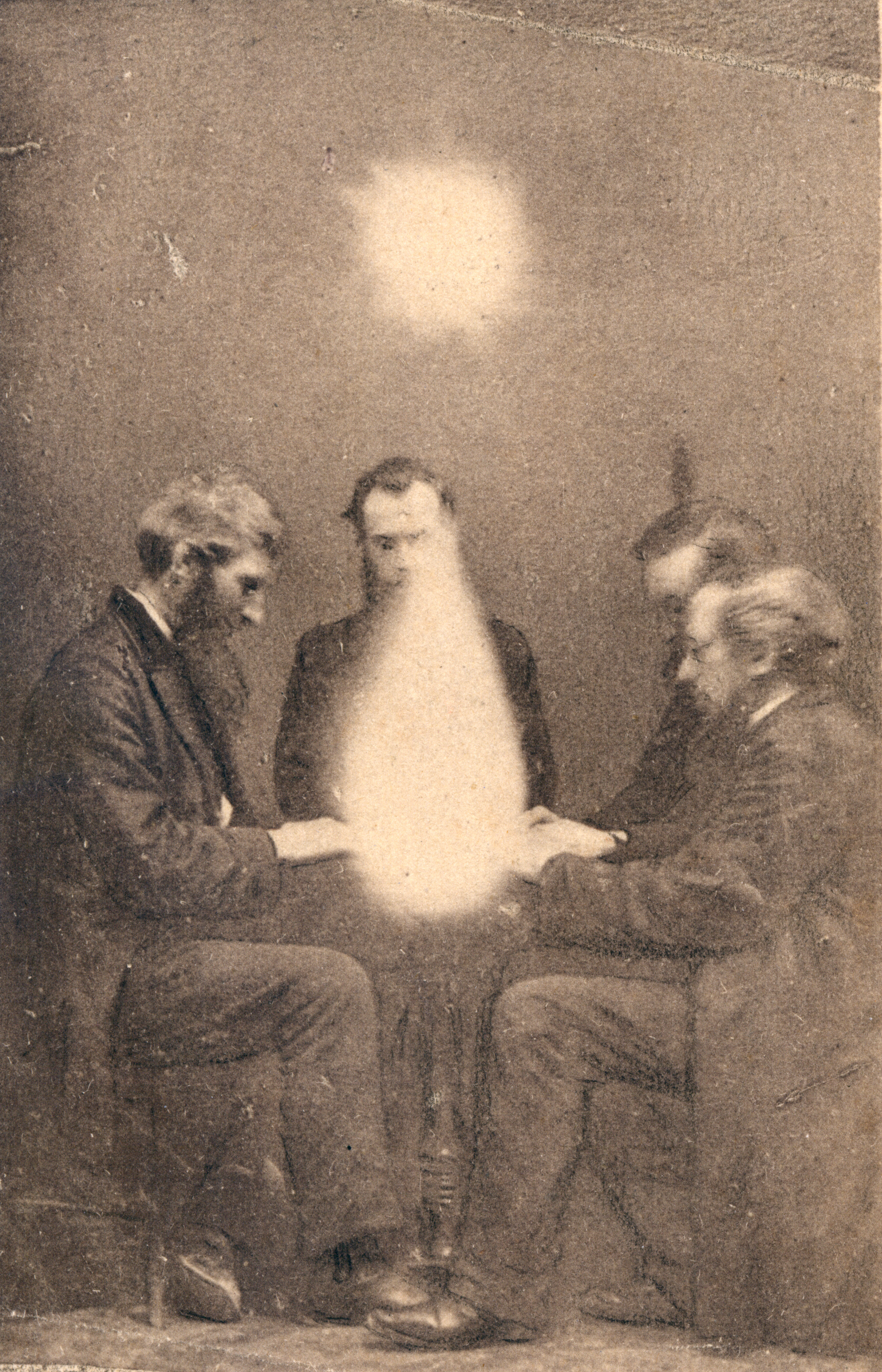
Trance mediumship is tightly bound to Spiritualism, the religious movement that believes the dead can and do communicate with the living. Modern Spiritualism is usually dated to the Fox sisters in New York State in 1848, and mediumship spread fast from there through 19th century America and Britain. In Spiritualist taxonomy, trance work belongs to mental mediumship, where the medium tunes in to spirit, as distinct from physical mediumship, where the phenomena are supposed to appear outside the medium's body.
Trance mediums were among the movement's biggest names. Paschal Beverly Randolph and Emma Hardinge Britten were celebrated lecturers and authors in the mid 19th century, and in France Allan Kardec built the Spiritist tradition around trance communications, publishing The Spirits' Book from sessions with selected mediums around 1860.
The inductions behind it had their own history. In 1836, French physician Charles Poyen Saint Sauveur toured the northeastern United States demonstrating mesmerism, and the craze that followed pulled in physicians and, oddly, a lot of clergy, who ran their own experiments with inducing trance through drugs, massage, and electrical stimulation. Several of those mesmerist ministers went on to become spiritualists. During séances, mediums were said to enter trances of varying depth, light to deep, that permitted spirits to control their minds.
It's also part of the history that mediumship drew serious skepticism. Investigations in the 19th century exposed widespread fraud, some of it using stage magicians' techniques, and scientific attempts to confirm mediumistic ability have continued to come up empty for over a hundred years. Any honest look at trance mediumship includes that record.
How practitioners train it
Mediums today generally train the way musicians train: slowly, in circles, with a lot of reps. Development circles and Spiritualist churches run structured exercises where students practice sliding between levels of trance, starting with light states and working deeper over months and years.
The foundational skills come first. Meditation and breathwork teach the focused attention trance requires. Students learn to recognize their own states, because the hardest part of trance work isn't getting in, it's staying aware enough of the doorway to come back with something coherent. In light trance a medium practices sitting in the power, a common exercise where you simply hold the altered state without trying to do anything with it. Later training adds blending and deepening: letting a spirit come closer to the medium's awareness, and practicing the shift between your own thoughts and the incoming communication. Ethics and safety get drilled too, good teachers insist you can always bring yourself back, ground afterward, and stop when something feels wrong.
Deep trance mediumship, where the medium steps aside and a spirit speaks through them, is the advanced end of this and the rarer for it. Most working mediums today practice lighter forms, where they hear, see, or sense messages while remaining essentially themselves.
What a session looks like
A trance session usually opens quietly. The medium settles, breathes, and begins the induction, often with eyes closed, sometimes with soft music or drumming. Those present sit in a circle and keep the atmosphere calm. As the state deepens, the medium's breathing and posture visibly change, and then the communication begins: in light trance the medium speaks in their own voice, relaying what they perceive, and in deeper states their voice, manner, even accent may shift as the spirit speaks through them.
Sessions run from a few minutes to an hour depending on depth. Closing is deliberate: the medium is brought back gradually, often with grounding, water, and a few minutes of quiet before anyone talks about what happened. A good session ends with everyone fully present again, not just the medium.
Common questions
Is trance mediumship the same as hypnosis? They share techniques and history, and 19th century mesmerism is the common ancestor of both. The difference is intent: hypnosis aims at a therapeutic result for the subject, trance mediumship aims at communication through the subject. In mediumship the medium, not an operator, is the one entering the state.
Is it safe? Practitioners treat light trance work as gentle, with the standard precautions: train with experienced teachers, keep yourself grounded, and end sessions properly. The deeper concern people raise is psychological, spending long periods in dissociative states isn't for everyone, and anyone with a history of dissociation or psychosis should talk with a clinician first.
How long does it take to learn? Years, realistically. Light trance and sitting in the power can come within months of steady practice, but deep trance mediumship is considered an advanced skill that most development circles treat as years of training, not a weekend workshop.
What does a trance feel like? Descriptions vary, but common threads are deep physical relaxation, a narrowing of attention, time distortion, and a sense of being slightly outside yourself. Most people have touched lighter versions already, that absorbed state you fall into with music or a long drive.
Has science confirmed any of it? No. Researchers have attempted to verify mediumship for more than a century without success, including a 2005 British Psychological Society experiment where self identified mediums showed no mediumistic ability under test conditions, and 19th century investigations exposed significant fraud. Belief in it remains widespread anyway, and for many people the value sits in the experience and the comfort, not the evidence file.
Can anyone learn trance induction? Most teachers say most people can learn light trance states with practice, since the mechanism is ordinary focused attention. Depth and reliability are where the time goes.