
By Bailey Romatoski ·
Your life path number is the number you get by reducing your full birth date down to a single digit (or a master number), and numerologists treat it as the core of your chart: the road you're on rather than the weather you're walking through. It's calculated once, from your date of birth, and stays with you for life.
What is a life path number?
The life path number is considered the most important number in your numerology chart. It's meant to describe the central theme of your life: the lessons, talents, and direction that keep coming up no matter what else changes. Think of it like a sun sign in astrology, a first reference point that everything else in a reading builds around.
How do you calculate your life path number?
You reduce your birth date to a single digit by adding the digits of the month, day, and year, and reducing each part separately, then reducing the sum. Here's the common method with a real example: born July 24, 1990. Month: 7 stays 7. Day: 24 becomes 2 + 4 = 6. Year: 1990 becomes 1 + 9 + 9 + 0 = 19, then 1 + 9 = 10, then 1 + 0 = 1. Add the parts: 7 + 6 + 1 = 14, then 1 + 4 = 5. Life path 5.
The exception is the master numbers. If a part of the date, or the final sum, reduces to 11, 22, or 33, you stop there; those aren't reduced further. So someone born on the 11th keeps an 11 in their calculation rather than collapsing it to a 2. Different numerologists handle the reduction slightly differently (some reduce the whole date in one pass, some reduce by parts as above), and the two methods occasionally give different answers, so it's worth checking both if you're on a boundary.
What do the numbers mean?
Brief sketches, as the tradition holds them:
- 1: independence, initiative, forging your own way.
- 2: partnership, sensitivity, holding things together.
- 3: expression, creativity, communication.
- 4: structure, work, building things that last.
- 5: freedom, movement, change as a way of life.
- 6: care, responsibility, home and family focus.
- 7: analysis, solitude, the inner search.
- 8: power, material mastery, ambition.
- 9: completion, service, the wider view.
- 11: the intuitive master number, inspiration and high sensitivity with real pressure attached.
- 22: the master builder, big vision plus the discipline to manifest it.
- 33: the master teacher, nurture and service raised to its largest expression.
Master numbers are read as intensified versions of their reduced roots (11 leans into 2's territory, 22 into 4's), with the tradition holding that they carry higher potential and a higher cost.
What does a numerology reading cover?
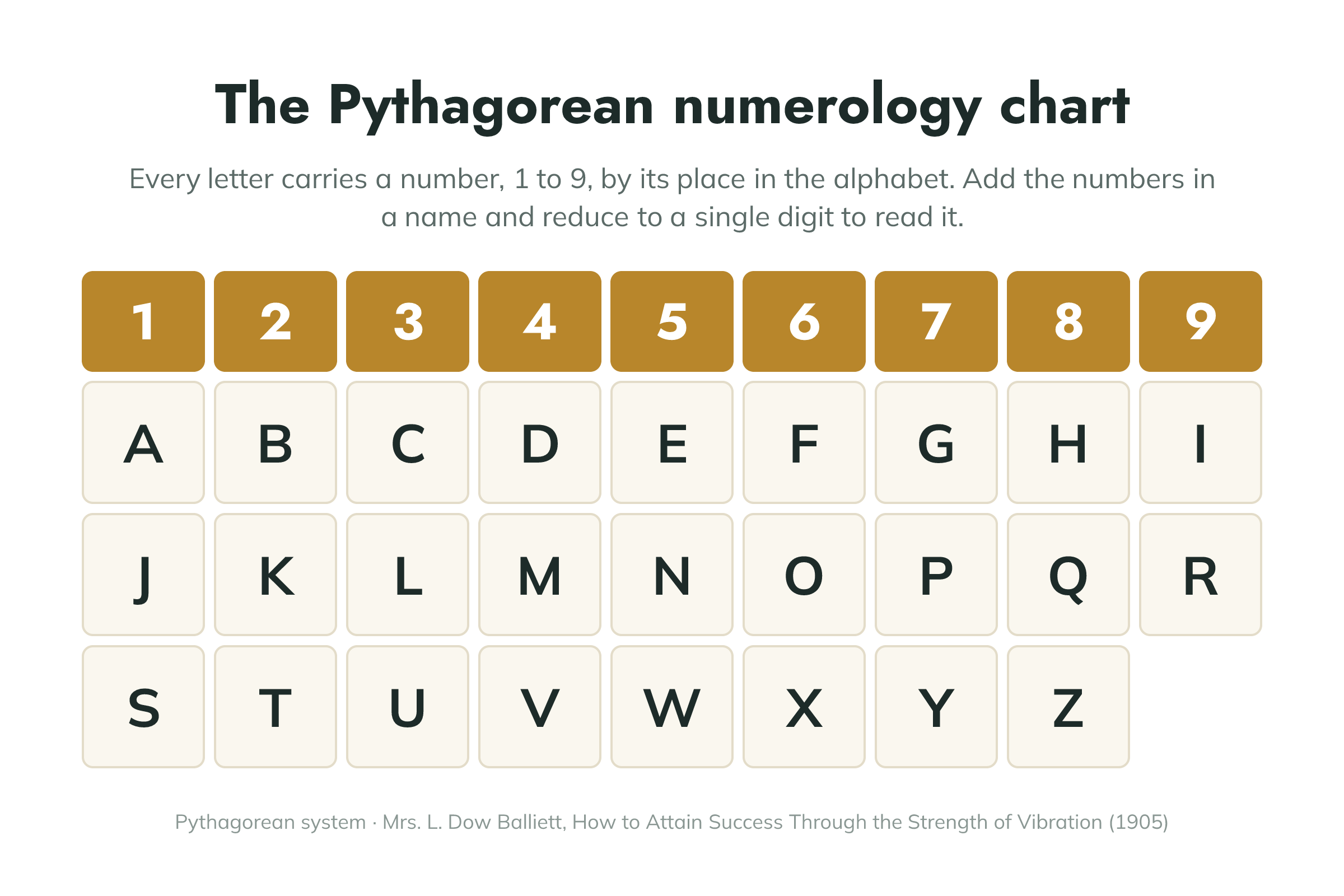
A full reading goes well past the life path. Practitioners typically work with your expression number (from the letters of your full birth name), your soul urge or heart's desire number (from the name's vowels), your birthday number, and personal year cycles that change annually. A reading usually connects these: your life path as the road, the other numbers as how you travel it. Sessions are usually conversational, and a good reader ties the numbers to concrete situations you bring, work, relationships, timing, rather than reading generic traits off a list.
Is numerology accurate?
Honest answer: there's no scientific evidence that numbers derived from a birth date or name predict personality or events. Controlled studies of numerology have not supported its claims, and it sits firmly in the category of symbolic systems rather than science.
That said, "accurate" isn't the only way a practice can be useful. Plenty of people find numerology valuable the way they find a good tarot reading or a reflective conversation valuable: it gives structure to self-examination, a vocabulary for patterns they've noticed, and a nudge toward decisions they were already circling. If a reading gives you a clearer view of your own priorities, it worked on the level that matters, as long as you're not making medical, financial, or legal decisions off a number.
So the honest framing is this: treat numerology as a mirror and a conversation, not a forecast. Be skeptical of any numerologist who promises certainty, pushes fear about your numbers, or upsells hard. A good one will tell you the same.
How do you get a reading, or start on your own?
You can calculate your life path number yourself in two minutes, and self-study is a fine way in: work your own chart, then friends', and see how the readings land. If you want a professional reading, look for practitioners who explain their method up front, who connect numbers to your actual life, and who are comfortable with your skepticism rather than threatened by it.
The bottom line
Your life path number comes from your birth date, runs 1 through 9 plus the master numbers 11, 22, and 33, and serves as the anchor of a numerology chart. Whether you take it as truth or as a reflective tool, it works best as a conversation starter with yourself. Hold it lightly, ask good questions, and use what resonates.